
#62: How to Listen to Your Body: Simple Shifts for Body Awareness
Most of us don’t listen to our bodies until they’re screaming at us. This episode shares simple shifts you can make to tune in more deeply… whether you’re brand new to body awareness or ready to go deeper. You’ll learn how to check in throughout your day, track emotions in your body, and work with your energy body for better alignment and decision-making.
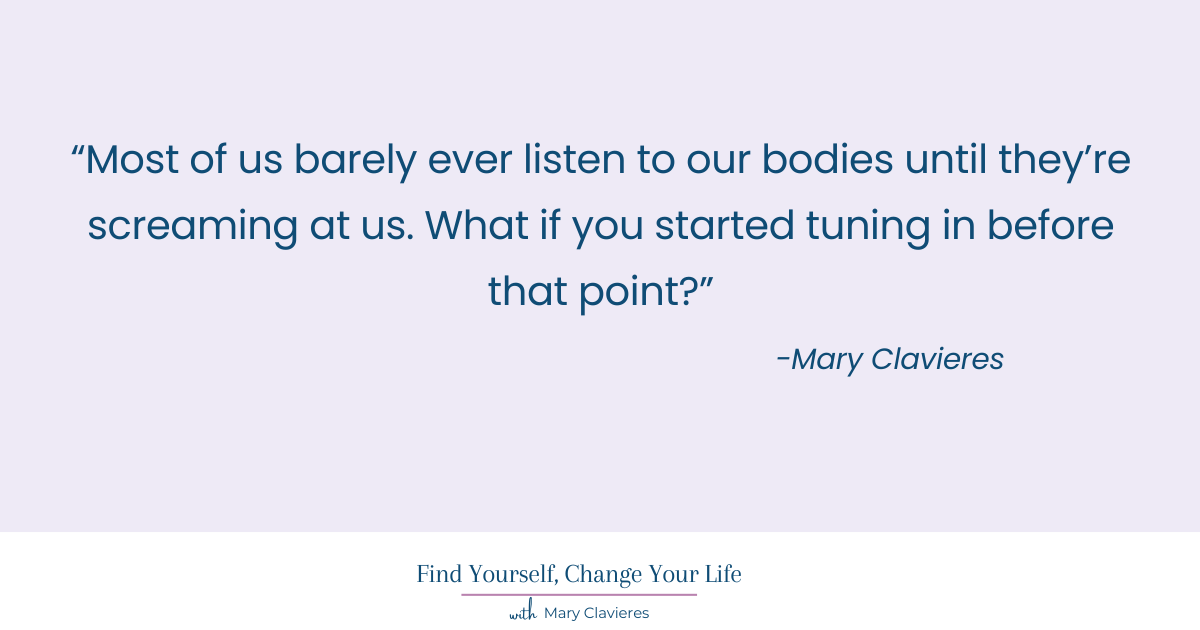
I’ll stand by this statement: so many of us barely ever listen to our bodies until they’re screaming at us.
And I consider it part of my life lessons and experiences to keep sharing this message, because I’ve learned how deeply listening to your body impacts everything. Your presence. Your relationships. How you approach your day. How you connect to your purpose. They’re all interlinked, whether you recognize it or not.
Some connections might seem obvious, others less so. But when you start tuning in and becoming more aware of your body, it will show you so many things.
Today I want to share simple shifts you can make to listen to your body more deeply, depending on where you are right now. If you’re brand new to this work, if you’ve been experimenting for a while, or if you want to take it deeper, there’s something here for you.
In this episode, we’ll cover three levels:
Beginners: Simple daily check-ins to build body awareness
Intermediate: Tracking emotions and where they show up in your body
Advanced: Working with your energy body for deeper alignment

If You’re Just Starting: Simple Check-Ins
When we talk about listening to your body, it can start with something very small. This doesn’t have to be a big production every time.
If I could help even one person today become aware enough to ask themselves “What does my body need right now?” I’d consider that a success. That’s how important it is to just get started with this type of work.
So let me ask: if you’re just starting out with listening to your body and you think, “What does that even mean? I stretch before my workout, isn’t that enough?” That’s great that you do that. But I’m talking about proactively tuning in throughout your day.
For example, think about your morning. Do you wake up and immediately jump out of bed to rush to the shower? Or scroll on your phone? No judgment on any of these things. But without tuning in, you’re kind of waking up and falling into the world and what’s happening right away.
That moment when you first wake up is actually a great time to pause and check in with your body.
I know when I wake up first thing in the morning and pause to check in, I always need to stretch. For some reason I scrunch in my sleep, so I always need a big, very mindful stretch. It’s getting up and taking the time to tune in and say, “Hey body, what do you need today?” And taking those stretches wherever they take you… your legs, your arms, side twists, whatever it is.
It’s really important to just start listening to see how you feel.
Ask yourself:
How am I feeling today?
Do I need to stretch somewhere?
Do I have a lot of extra energy that needs to be released?
Am I really tired?
If it’s first thing in the morning, you’re probably not going back to rest right away. But those are the types of things you can look out for.
And here’s the important part: bring that awareness with you throughout the day.
It’s not only about stretching first thing in the morning or right before bed. It’s also tuning in throughout the day. Maybe you have back-to-back calls. Between your calls, you tune in and say, “What do I need right now?”
It might be a stretch. It might be an energy reset break, something more active than stretching. Maybe you need a little walk or a few jumping jacks. It can really be anything, depending on what you have going on, how your workspace is set up, and what you’re feeling in that moment.
The thing is to really just tune in and say, “What does my body need? How am I feeling? What do I need?”
If you start to do that at least once, but let’s say anywhere from one to three times a day, you’re already going to notice so many things about yourself. One to three times a day, daily, for about a month, and you’re going to build this habit of checking in.
Simple times to check in with your body:
First thing in the morning before you get out of bed
Between meetings or tasks throughout your day
Before making decisions (big or small)
Right before bed as you wind down
You’ll probably find before the month’s over that you end up checking in more often. As you get more aware, your ability to expand into that and do more with it grows. That’s definitely how it happened for me.

When I first started with my daily walks, they were only three to five minutes. Very small, very short. But it got me in the habit of getting outside for a few minutes. Even if it was just a circle around our block, it counted. It was something.
So I say the same thing now with this. If you’re just getting started, check in a few times a day. Write yourself a Post-it note if you need to. Keep it on your computer screen or block five minutes in your calendar so it pops up as a reminder. Whatever you need to do that works for you—please go ahead and do that. Give yourself that space, because it’s going to get you to start looking at things a little differently.
If You’re Ready to Go Deeper: Track Your Emotions
Now, if you’re someone who’s already used to checking in—you tune in a decent amount, you walk or do yoga—the next thing I’d say is to pay attention to how you feel within your body at different times.
Especially when you have big emotions, tune into where those show up in your body.
Questions to ask yourself:
How does love or excitement feel in my body?
How does nervousness feel?
How does anger feel?
Where do I feel joy or peace?
Whenever you’re feeling any type of surge in emotions, tune in and identify where it’s coming from within your body.
As you build that practice, you’re going to be able to recognize what the different feelings are and how they show up. But you’ll also be able to go deeper into:
What you’ll discover:
Is this my body’s reaction?
Is this something coming from my mind and fear?
Is this something my body is telling me I’m on the right track with?
What pattern is this part of?

There will be a lot of different things you can decipher from it. But in order to be able to decipher and see what the message is, you need to first know where these things show up, how they show up for you, and then start digging into what they mean.
I like to recommend keeping a little notebook by your side or using the notes app on your phone. Just jot down different times and how these different things are showing up for you. Over time you’ll be able to put some patterns together.
I talk about this a lot with decision-making clients. If someone has a Decision Making Accelerator session with me, we talk about tracking emotions—especially for emotional authority, which is about half of the population. (If you’re new here, you can check out the Decision Making Series starting with Episode 48 to learn about your decision-making style.)
When you keep tracking how the different body signals show up, what they mean for you, how these emotions present themselves, you’ll be able to go deeper into what it’s trying to tell you.
Especially for things like stress—if you’re aware of how stress shows up in your body, or how worry or anxiety show up, then when it’s happening you can get the signals earlier. The more you dive into it, the more you learn, you’ll get the signals earlier and earlier. You’ll be able to put things in place that are more preventative instead of always reacting.
Instead of getting to the point where you’re so stressed out and spinning about something, you’ll recognize the earlier signs your body gives off. You’ll say, “Okay, you know what, I need to step in and change something about what’s happening right now. I need a break. I need this, I need that”—so that it doesn’t get to that point.
Our bodies are talking to us all the time, I promise you. It’s a question of if you’re listening or not.
These types of practices can help you build your relationship with your body so that it’s not only talking to you when you get to that very stressful point.
I know I’ve shared this story on the podcast before, but I had times before I left my corporate job where I woke up one morning with all of my teeth feeling like they were going to fall out. Long story short, it turns out I was grinding my teeth at night because my subconscious was processing all the things—the situations I was in.
What I came to realize is that it’s going to show up in your body no matter what. So the more you can do things to take care up front, the less you’ll have those extreme moments later on. They might still happen—we’re not perfect. But it can greatly change your life if you pay attention.
It can prevent some longer-term situations where your body just can’t handle it anymore.
So that’s the next level: really paying attention to what you need in these moments. Tracking the emotions, where they show up in your body, tracking all that and seeing what it means for you so you can start to learn that body communication.
You can use it for your decision-making. You can use it when you’re in different situations with people, identifying what’s really going on. Working through even extreme emotions or triggers that come up. Like, “Oh, I always get angry in this type of situation.” You’ll start to see where it takes shape in your body, and you can get curious about what to do next with that information.

If You’re Already Aware: Work With Your Energy Body
If you’re familiar with these different pieces—you tune in, you check in, you know where the emotions show up for you—then I’d say the next phase is really looking into the energy realm and the energy body.
It’s not just your physical body you’re taking care of—it’s also your energy body. And what does that look like?
Questions to explore: - Are there things on a more subtle level that are draining me? - What do I need to start paying more attention to energetically? - What really fuels me in a way that I want to keep in my toolkit?
For me, walking out in nature is something that refuels me every time. My physical body, my energy body, all of it. Clears my mind. All of the things.
Conversely, if I know I’m in a busy place—like an airport—I know there’s lots of other people’s energy all around me the whole time. So I want to take some measures to protect my energy and protect my space, and even my body.
When you work in that realm, it looks a little bit differently. And as always with this podcast, take what resonates and leave the rest.
But I will share in terms of energy, especially in busy spaces and traveling: I teach this to my daughters too. Make an energy bubble.
Just pretend that you have a blanket of energy, a bubble around you, that’s allowing people to not come into your space. In the movie Dirty Dancing, they talk about “This is your dance space, this is my dance space.” It’s a similar kind of thing with your energy bubble.
You just imagine—close your eyes for a moment—imagine this bubble coming up around you. You can say, “This is my energetic space. Your energetic space is outside of this bubble, so no need for your energy to come any closer.”
You can play around with what distance you make that, but give yourself a little room. Even though we can’t see it doesn’t mean it’s not helping us in some way. It could even be just that setting that intention is something that will help you. You might never know exactly how, but it can still help.
For me, I definitely take into account those types of practices. If you’d asked me before I was even paying attention to my physical body, I would not have said that. But since I’ve done that and gone through this process and gotten more and more aware over time, I’m able to do it now.
Again, depending where you are in all of this, you’ll see what might be the next step on your journey with it.
But the important thing is to start building—and continuing—a relationship with your body. To recognize that it is communicating with you all the time. That’s what I really want you to take away from this.
Your Next Step
In terms of integration and what you can do next with this information: please identify where you are and then get curious. What’s the next step you could take?
Choose your next step based on where you are:
If you’re new to body awareness:
Start with one daily check-in (morning, midday, or evening)
Try a simple body scan when you wake up
Ask yourself “What does my body need right now?” once a day
If you’re ready to track emotions:
Keep a notes app or small notebook handy
Write down where you feel different emotions in your body
Notice patterns over a week or month
If you’re exploring energy work:
Practice the energy bubble visualization in crowded spaces
Notice what drains you vs. what refuels you
Get curious about how different spaces feel energetically
Mind Body Connection Unlocked has so many different tools you can try. There are even free meditations you can download after you purchase the book, plus a companion workbook. Take a look at all of it and find the things that work for you.
You’ll see things can be supportive to you or they can be draining to you. And honestly, it’s all part of the whole.
If you’re at the energy body piece, I’m super excited for you because there’s a whole different world out there that you’re going to start learning about in a different way. It’s super powerful.
So here’s your invitation: Take one of these areas, identify which area speaks to you, and identify one action within that area that you can take so you can start listening and tuning in more to your body.
It’s such a powerful way to move about the world.

Frequently Asked Questions
How do I know if I’m actually listening to my body or just overthinking?
When you’re truly listening to your body, you’ll notice physical sensations—tightness, expansion, warmth, tingling, heaviness. It’s a felt sense, not a mental analysis. Overthinking happens in your head and usually involves loops of “What if?” or “Should I?” Body wisdom is quieter, more grounded, and often shows up as a simple yes/no sensation before your mind starts analyzing.
What if I check in with my body and don’t feel anything?
This is completely normal when you’re just starting out. Your body might be giving you signals, but you haven’t built the awareness to notice them yet. Start with something simple: notice if you’re holding tension anywhere (shoulders, jaw, stomach). Notice your breath—is it shallow or deep? Even noticing “I don’t feel anything” is information. Keep practicing daily check-ins, and over time the signals will become clearer.
How often should I be checking in with my body throughout the day?
If you’re just starting, aim for one to three times per day. Set reminders if you need to—morning when you wake up, midday between meetings, and evening before bed are good anchor points. As you build the habit, you’ll naturally check in more often without needing reminders. Eventually it becomes second nature.
Can I really protect my energy with a visualization like an energy bubble?
Yes. Even if you’re skeptical, setting the intention creates a boundary. Think of it this way: your intention directs your energy and attention. When you consciously decide “this is my space,” you’re less likely to unconsciously absorb what’s happening around you. Many of my clients who travel frequently or work in high-stress environments swear by this practice. Try it and see what you notice.
How is listening to my body different from just paying attention to whether I’m hungry or tired?
That’s actually a great starting point! Hunger and tiredness are your body communicating basic needs. Listening to your body goes deeper—noticing where emotions live in your body, recognizing stress signals before they become overwhelming, understanding your unique decision-making style, and working with your energy. It’s moving from reactive (only noticing when you’re starving or exhausted) to proactive (checking in regularly so you can prevent getting to that point).
What if I notice my body is telling me something but I can’t do anything about it right now?
Simply noticing is powerful. If your body says it needs rest but you’re in back-to-back meetings, acknowledge it: “I hear you, I need rest. I’ll give you that as soon as I can.” Then actually follow through when possible. Sometimes the act of acknowledging what your body needs reduces the intensity of the signal. And over time, you’ll get better at building in those breaks proactively.
How does tracking emotions in my body help with decision-making?
When you know how different emotions show up in your body, you can differentiate between fear-based reactions and genuine body wisdom. For example, if “excitement” feels like an expansion in your chest and “anxiety” feels like tightness in your stomach, you can tell the difference when facing a big decision. This is especially important for the roughly 50% of people with emotional authority in Human Design—you’re designed to make decisions through your emotional wave, not from your mind. (Check out Episode 48 to learn more about decision-making styles.)
I do yoga and exercise regularly. Isn’t that enough for body awareness?
Yoga and exercise are fantastic practices and definitely help with body awareness! What I’m inviting you into is bringing that same level of awareness into the rest of your day. Can you notice how your body feels between meetings? When you’re making a decision? When you’re in a difficult conversation? The goal is to have that body connection be continuous, not just during your workout. Think of exercise as your practice ground, then bring that awareness into daily life.
Ready to go deeper?
Check out Mind Body Connection Unlocked—Part 4 is entirely dedicated to understanding your body, with practical tools, exercises, and guided meditations. You can also explore the Decision Making Series starting at Episode 48 to learn how your unique body is designed to make aligned decisions.
Links & Resources
Get Your Free Human Design Chart
Download the Decision Making Workbook
The Decision Making Accelerator: Book a Decision Making Accelerator Session Here
Connect with Mary:
LinkedIn: linkedin.com/in/mary-clavieres-19917a7/
Instagram: @mary.clavieres
Voxer: @maryclavieres
Read Mary's Book:
Mind Body Connection Unlocked is now available! Order your copy and dive into how mind and body alignment can support lasting change in your life.
