Behind the Scenes: A Mini Human Design Reading About Energy, Identity and Showing Up
Hello and welcome to Find Yourself, Change Your Life. I’m your host, Mary Clavieres. This podcast is here to help you rediscover yourself and become the leader of your life, however you want that to look.
For today’s episode, we have a very exciting treat for you. It’s something different that I’ve never done before on this show, and I’m really looking forward to it.
We’re going to be talking about Human Design live with another person here with me. We’re going to have a conversation about what Human Design looks like in everyday life and how people navigate different things on the journey using Human Design as a tool.
I wanted to bring this here to share with you as a listener to help give you a perspective on just how this type of information can help you, what you may use it for in your life, understanding that everyone’s chart is unique and different.
Meet Chelsea Lauren
I have a dear friend of mine, Chelsea Lauren, on the show today. We’re going to be talking about a portion of her Human Design chart.
Chelsea is an incredibly lovely human who is also behind the editing of my book, Mind Body Connection Unlocked. She’s really a superstar. I actually think it was the universe that put us together because when she asked me how we met, I couldn’t even remember. I think I found her on Instagram, but how? I don’t usually just find people on Instagram. It was a whole thing.
Chelsea’s company, Represent Publishing, is a big part of how my book actually got published—because otherwise it might not have. So I’m thrilled to have her here.
How Chelsea Discovered Human Design
Mary: I’m curious to hear from you before we jump into your chart—what first got you thinking about and experiencing Human Design? What intrigued you?
Chelsea: I honestly had never heard of Human Design until I came across you, so you were my first introduction to it.
Mary: Actually, I just have to say that is not planned. I totally forgot that!
Chelsea: I have always loved astrology and bettering myself. I go to therapy and I’m always trying to find things within the universe to work toward and work on. So your book was like a big wake-up call to me, what I needed in that moment. At that point I was seven months postpartum, so as a first-time mom trying to navigate myself in that space.
Then my friend got really into Human Design and suddenly I was hearing about it in other locations. Hold on, this is a thing. So a few months ago she did a Human Design reading with astrology, and that brought me back to your podcast and listening more to it. That’s how we reconnected again on this level.
I’m excited to see how this all connects with what I’m working on and astrology. I am a huge fan of the Enneagram and the Myers-Briggs personality tests and combining all of them to put my best self forward, I guess.
You’re a Projector: The Lighthouse Energy
Mary: What I like to start with generally is how someone’s energy works, because this is what the chart is really showing. It’s showing how your energy works, how you’re meant to move about the world.
Chelsea, you are a projector, and this is one of the five types. But it operates very differently from a large portion of the population.
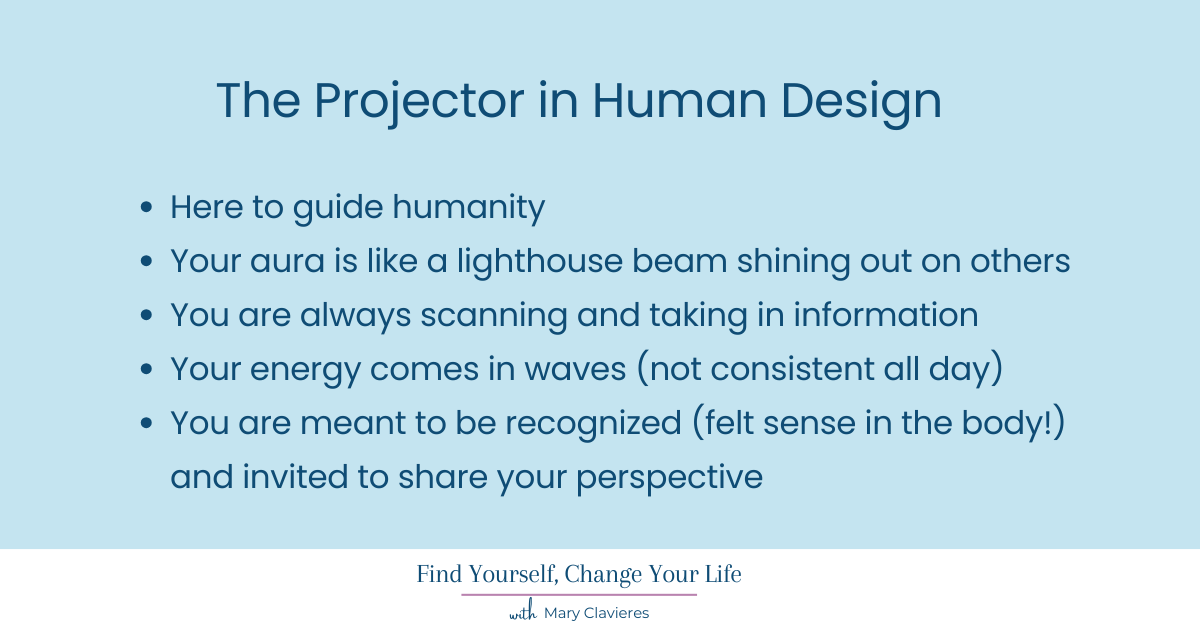
70 to 75% of the population has a defined sacral, which I say is the energy battery of the body. Projectors are one of the three other types that don’t. And what happens is you can really be conditioned quite a bit by other people that have that energy battery.
Being a projector, your energy is not meant to just continue all day long. You’re not meant to just get up and go and run throughout the day. Your energy happens in waves. You might get a burst of energy and work for a good two to three hour sprint and then be done.
Because what you’re actually doing as a projector is you’re taking in everything around you all the time. Your aura works like—if you envision a lighthouse and the lighthouse beam that goes out and shines on other people—a projector shines their aura out to other people all the time.
So you’re always scanning, you’re always taking things in. I wouldn’t be surprised if you felt you were someone that’s pretty good at reading people or kind of getting some of that nuance or layers to what someone is saying to you, where you can tell things by the tone. All of that is really part of being a projector and how you operate.
All of that is also using energy. So you’re constantly throughout the day taking in things. Your battery operates differently because you don’t have consistent access to that energy all day long.
Chelsea: Yeah, that’s all very accurate.
The Morphing Pattern
Chelsea: Kind of deconstructing myself from 2021 till current day—I figured out that I had ADHD in 2021 and all of that stuff. The biggest thing I always say to people is that I always morphed myself into whoever I thought someone wanted me to be in order to exist in the world easier.
Like trying to be the better daughter, trying to be the best student so I wasn’t annoying to the teacher. Now trying to deconstruct all of that and figure out what society placed on me and who I am—I’m literally asking myself when I do something: Do I enjoy this, or was I told that I had to enjoy this? And it’s really eye-opening.
Mary: Yeah. And that’s comforting, I guess, to hear that there’s a reason.
Chelsea: Oh, yeah.
Recognition and Invitation: Why “I Don’t Need a Solution” Resonates
Mary: The way your aura shines out on other people—other people might not always want to be under that spotlight of your aura. It might make them feel uncomfortable. And you can probably sense that from people.
This gets into a little bit about how the projector works, because the strategy is to wait for the invitation. There’s actually really two parts to this. There’s wait for the invitation, but first, it’s important to be recognized.
Projectors are here to guide, but you’re not here to guide just anybody. You’re here to guide people that see you and appreciate you for your guidance.
If you were to think of a time when you see something very clearly—you know it very clearly because you’re scanning all the time, you get these layers and nuance—you might go share with someone, “Oh, you could do this this way, it’ll work a little better.” You might try to guide someone that might not want to be guided by you. It might be seen as over-sharing in a way because you’re trying to help.
Chelsea: I have been told, “I don’t need a solution, I just want to vent.”
Mary: Okay, see? Yes, there you go.
So as you go on this path and you kind of deepen into your projectorness and how you’re meant to live with it and work with it, it’s really about waiting to see. That recognition is felt in your body. This is why I feel so passionately about mind-body connection—because all of this stuff actually shows up in your body. It’s not something out there. It’s really in you.
You have to feel the recognition from the other person and be invited to share something with them.
The recognition is going to be felt in your body of, “Oh, I feel seen and appreciated. They know that I’m someone they can come to on this. And so here I am sharing. I feel good about sharing with them.”
Your 2/4 Profile: The Hermit Who Needs People
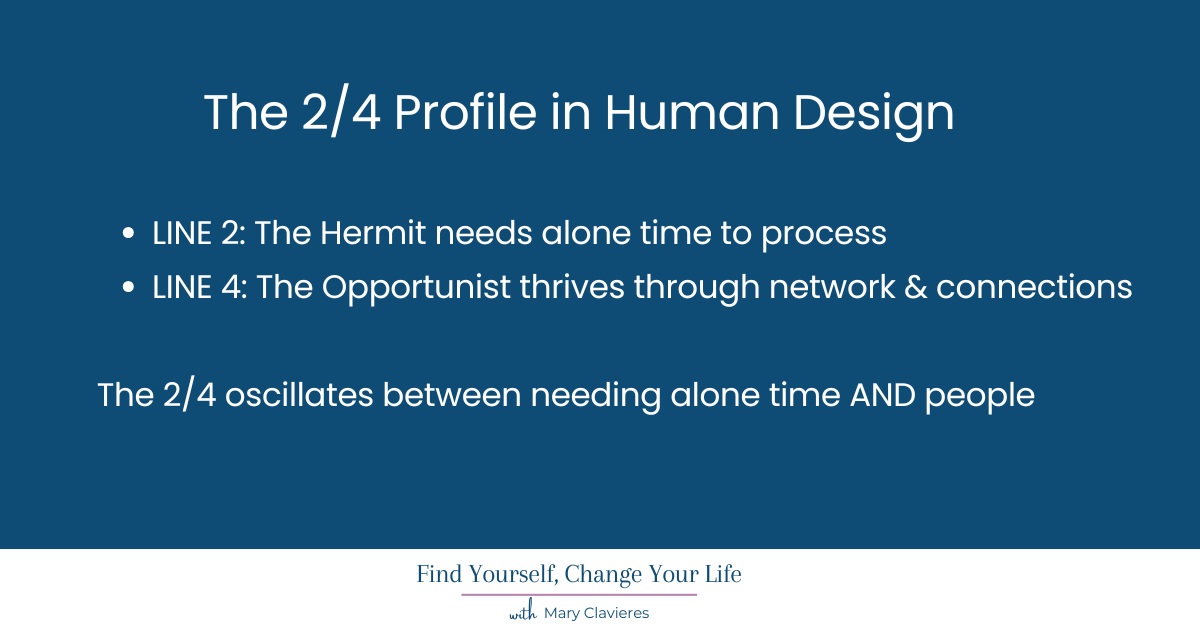
Mary: Your profile is a 2/4. The 2 is called the hermit and the 4 is called the opportunist.
The hermit side of you really needs to have alone time to process things. You need to have time away from people to really integrate and understand what’s happening for you.
Chelsea: Yeah, that tracks because I am an extroverted introvert. I love being social, I love being around people, but I need time alone to recharge. And I’ve also noticed within the past few years that I need time to process things alone before I can verbalize them to other people.
Like with my husband, I’ll tell him, “I need to sit with this for a little bit before I can have a conversation with you about it.” Because I need to figure out how I’m feeling first.
Mary: Yes, exactly. That’s the hermit.
The 4 line, the opportunist, is all about your network. You have a very strong network of people around you. The opportunist is someone who has these connections and opportunities come through those connections.
So you have this interesting dynamic where you need alone time to process (the hermit), but you also thrive through your network of people (the opportunist).
Rest Isn’t Giving Up Control—It’s Trusting
Mary: One of the biggest things for projectors is understanding rest. And not just like, “Oh, I need to sleep more.” It’s about recognizing when your energy is done and honoring that.
For projectors, there can be this feeling of, “If I rest, I’m giving up control. Things won’t get done.”
Chelsea: Yes, exactly.
Mary: But rest for you isn’t giving up control. Rest is trusting. Trusting that your energy will come back. Trusting that you’ll know when it’s time to work again. Trusting that you don’t have to force it.
When you try to push through when your energy is done, that’s when you start to feel bitter. That’s the not-self theme for projectors—bitterness. It’s that feeling of, “Why doesn’t anyone see me? Why doesn’t anyone appreciate what I’m doing?”
But when you honor your energy and rest when you need to rest, when you wait for recognition and invitation, you get to experience success. That’s the signature theme for projectors—success.
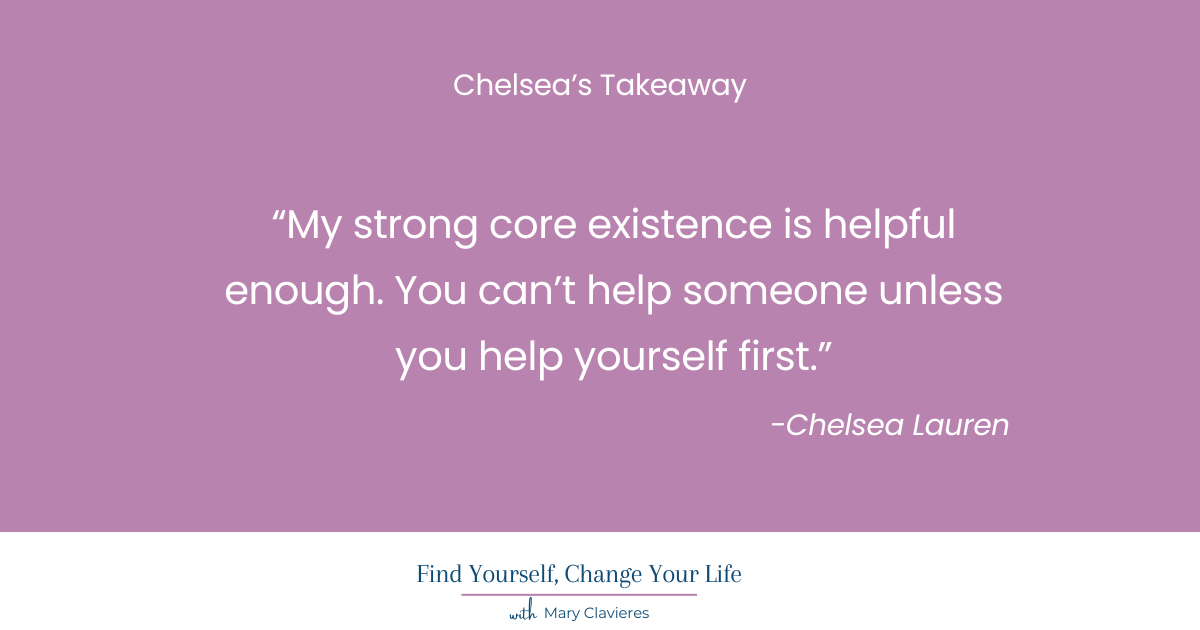
Chelsea: That’s really helpful. I think pulling myself back a bit and acknowledging that my strong core existence is helpful enough. And again, it goes back to you can’t help someone unless you help yourself first.
And this is another reason to take the time to take care of myself, because that always gets put on the back burner.
Chelsea’s Big Takeaway
Mary: What’s one thing that you’re taking away that you’re really looking at, that you’ll say, “Oh, this is really interesting, I’m going to pay more attention to this,” or some kind of aha moment that you’d like to share?
Chelsea: I think really just pulling myself back a bit. That distinction was helpful. And just acknowledging, like you said with the lighthouse, that my strong core existence is helpful enough.
And another reason to take the time to take care of myself, because that always gets put on the back burner.
Mary: It’s honestly the number one thing that you can do. In my life now, it’s such a priority for me. I can’t not do it because I do not feel well if I don’t. It eventually becomes such a habit in that way that even my family—my husband and my girls—they know. My husband’s like, “Do you need to go for a walk?” I’m like, “Yes, I do.”
Chelsea: Yes, I want to get to that point.
Mary: You will. It’s a process. It’s part of the life journey. But paying attention to that is already fantastic for you. So you’re well on your way.
About Chelsea and Represent Publishing
Chelsea’s company, Represent Publishing, is the way to go if you have book plans and are going the self-publishing route. Every time I was like, “I don’t know about this” or “This whole book is terrible,” Chelsea was like, “What? No!”
We’re our own worst critic. So it’s really important to have someone that’s rooting for you along the way.
You can find Chelsea and Represent Publishing at [links in resources].
What This Reading Teaches Us
Even if you’re not a projector, this conversation shows how Human Design can help you:
Understand your energy patterns instead of fighting them
See your conditioning (like morphing into who others want you to be)
Give yourself permission to work with your design, not against it
Recognize when something is “you” vs. what society told you to be
If you’re curious about your own Human Design chart, you can get your free chart at maryclavieres.com/getyourchart.
Thank you so much, Chelsea, for being open to this conversation and sharing your experience with all of us.
Find Chelsea here:
Website: https://representpublishing.com/
Links & Resources
Get Your Free Human Design Chart
Download the Decision Making Workbook
The Decision Making Accelerator: Book a Decision Making Accelerator Session Here
Connect with Mary:
LinkedIn: linkedin.com/in/mary-clavieres-19917a7/
Instagram: @mary.clavieres
Voxer: @maryclavieres
Read Mary's Book:
Mind Body Connection Unlocked is now available! Order your copy and dive into how mind and body alignment can support lasting change in your life.
Frequently Asked Questions
Q: What is a projector in Human Design? A: A projector is one of five energy types in Human Design. Projectors make up about 20% of the population and are here to guide others. Unlike generators (70% of the population), projectors don’t have consistent energy all day—their energy comes in bursts and waves. They’re designed to work in sprints, rest, and take in information about the people around them.
Q: What does it mean to wait for recognition and invitation? A: Projectors are here to guide, but only when their guidance is wanted and valued. Recognition means someone sees you for your gifts and wisdom. Invitation means they’re asking for your input. When you try to guide someone who hasn’t recognized you or invited you, it often feels like rejection or like you’re “too much.” The classic example: offering solutions when someone just wants to vent.
Q: What is a 2/4 profile in Human Design? A: The 2/4 profile combines the hermit (2nd line) and the opportunist (4th line). The hermit needs alone time to process and recharge. The opportunist thrives through their network of people and connections. This creates an interesting dynamic where you need solitude AND people—just at different times.
Q: How do I know if I’m a projector? A: Get your free Human Design chart at maryclavieres.com/getyourchart. Your chart will show your type. If you’re a projector, you’ll have an undefined sacral center (the square in the middle of the chart). You might also recognize yourself in these patterns: energy comes in waves, you’re good at reading people, you feel bitter when unrecognized, you’ve been told you’re “too much” when offering advice.
Q: What does deconditioning mean in Human Design? A: Deconditioning is the process of unlearning all the ways you’ve been conditioned to be someone you’re not. Society, family, school, work—they all condition us to operate in certain ways. Human Design shows you how YOU’RE designed to operate. Deconditioning is asking yourself: “Do I actually enjoy this, or was I told I had to enjoy this?”
Q: Why do projectors need more rest than other types? A: Projectors don’t have a defined sacral center (the body’s energy battery). This means they don’t have consistent, sustainable energy all day like generators do. Projectors are constantly scanning and taking in information about others, which uses energy. Rest allows them to discharge the energy they’ve absorbed and recharge for their next burst of productive energy.
Q: What is the not-self theme for projectors? A: Bitterness. When projectors aren’t living according to their design—when they’re trying to work like generators, forcing their guidance on people who don’t want it, or not resting when they need to—they feel bitter. “Why doesn’t anyone see me? Why doesn’t anyone appreciate what I do?” The signature theme (when living in alignment) is success.
Q: Can I combine Human Design with other systems like Enneagram or Myers-Briggs? A: Absolutely! Human Design is just one tool in your self-discovery toolkit. Many people, like Chelsea, use it alongside astrology, Enneagram, Myers-Briggs, and therapy. Each system offers different insights. Use what resonates and helps you understand yourself better.