
#49: How to Make Better Decisions When You Need Time to Process [Emotional Authority | Decision Making Series]
Today we're diving into emotional decision making, also called emotional authority in human design. This is the second episode in our Decision Making Series, and it's a big one—roughly 50% of the population has this decision-making style. So there's a good chance this is your style, or someone close to you operates this way.
If you haven't listened to last week's kickoff episode (Episode 48), I'd encourage you to start there. That episode lays the foundation for understanding how decision making connects to your mind-body connection, why conditioning matters, and how we're exploring seven different decision-making styles throughout this series.
What Is Emotional Authority?
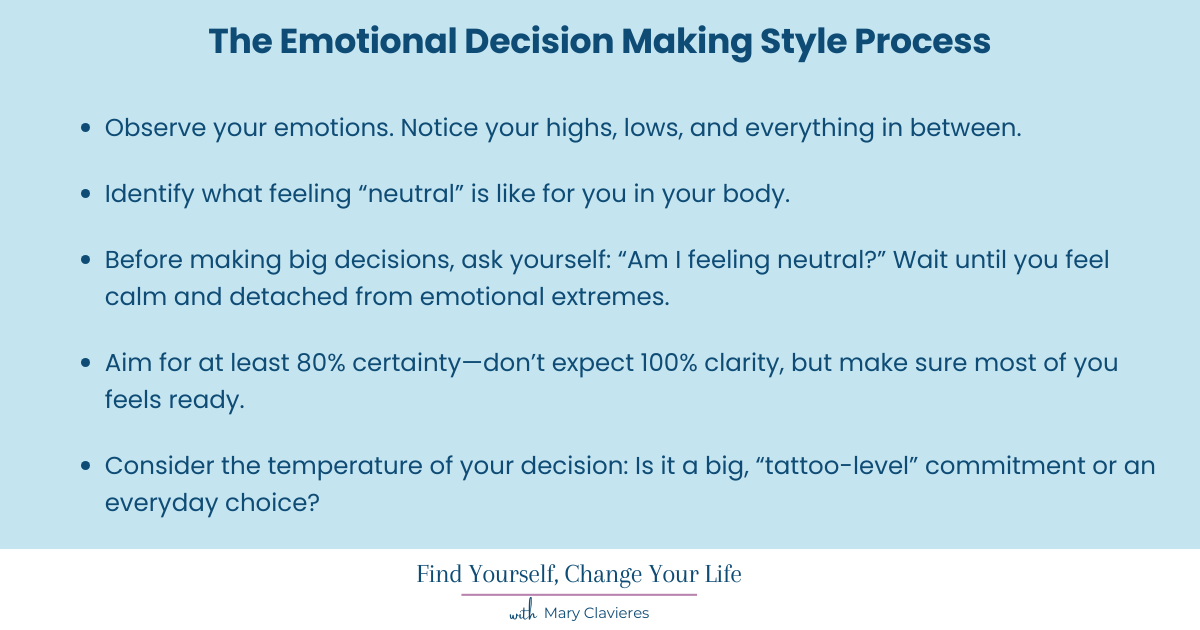
Here's the core principle: if you have emotional authority, you're meant to ride the highs and lows of your emotions before making a decision. You wait until you feel neutral—a felt sense of neutrality in your body—before you decide.
Let me say that again because it's so important:
Ride the highs and lows of your emotions. Let them play out. Wait until you feel neutral about whatever you're deciding on—with a felt sense of that neutrality in your body—before you make a decision.
You are not meant to make decisions in the moment when you're feeling on an emotional high or an emotional low. You have to wait until you feel detached from it.
What Does Neutrality Actually Feel Like?
Neutrality means you don't feel polarized in either direction. It's more like having an observer lens—you're able to step away from the situation a little bit and say, "Okay, yeah, I can decide on that now."
But here's what's crucial: you pay attention to how it feels *in your body*.
As you build this relationship with your mind-body connection, you'll learn what your high emotions feel like in your body, what your low emotions feel like, and what neutrality feels like. Maybe you feel tension in your shoulders during a low, or your palms get sweaty. Maybe during a high, you feel expansive, like you're on top of the world—"This is the best idea ever! We can do this!"
Paying attention to how these emotions show up physically will help you observe what's going on and move through those emotions differently. You'll arrive at your neutral point more smoothly than if you're not paying attention to the highs and lows.
The Temperature of Your Decisions
Now, do you have to do this for every decision? No. It depends on the temperature of the decision you're making.
My human design teacher Jamie Palmer shares this analogy: decisions are like an outfit, a haircut, or a tattoo.
Outfit decisions: Low-stakes, everyday choices. Not a lot of worry about long-term impact.
Haircut decisions: Yes, you might not like it, but it'll eventually grow out.
Tattoo decisions: These are permanent, big life decisions.
This emotional authority process is very much focused on those tattoo-level decisions—the big stuff like taking on a new position at work, deciding to start your own business, moving across the country or to another country. Those are the decisions that warrant paying attention to your emotional waves and waiting until you get to neutral.
Clarity Comes Over Time, Not in the Moment
This is about clarity coming over time instead of in the moment. You're not meant to make decisions in the moment. That's a big no-no.
If you're feeling high and you make a decision in the moment, it's not going to end well. Same with feeling low and making a decision in the moment. I don't really believe there are mistakes in life in a certain way, but it's not going to end up with the result that you really want.
Think back to times in your life where you've made big decisions. Can you see—did you make that decision from an emotional high or low? And how did it end up?
This is a great reflection I give to people whenever I'm doing a decision-making reading. Take a look at your past big decisions and ask: What emotional state were you in? How did that work out for you? It's pretty eye-opening because since you're feeling all this in your body, you might not even realize it that much. This is another reason to really pay attention to your mind-body connection—it's all right there for you.
So if anyone is pushing you to make a decision in the moment and it's a big decision—permission to take a little more time.
Real-Life Examples
Let me share a couple of examples of how this shows up.
Client Example #1:
I had a client who was looking to take another job. She came to me and said, "I really don't know how to decide if this is the job. I feel really great about certain things—I just talked to the person, this feels good. But then what about that?" She was going through all these different phases.
I said, "Well, your decision-making style is to wait until you're neutral." She has a yoga and meditation background, so it was pretty easy for her to understand and attach to that because she had familiarity with how neutral feels to her.
I told her, "You have to wait through these waves—feel those highs, those lows—and then wait until you're neutral before you decide. You can't decide in this moment because you don't sound neutral about it." There were things that were really exciting to her and then other things where she was like, "Oh, I don't know about this."
Here's another thing to note with emotional decision making: you won't ever necessarily feel that a yes is 100% yes. You won't feel 100% clear even when you reach that neutrality. It likely won't feel like you're 100% sure.
But if you feel 80% sure—80% or more—then you're good to go.
If you feel like 80% of you is saying yes, like "I feel calm, cool, collected, I'm seeing this direction, I feel neutral in my body, I feel 80% or more that this is a yes," then it's a yes. There can be a lot of doubt with this decision-making authority because of that, so I just want to clarify that for you.
Client Example #2:
Another client was also in the middle of some job changes. She was looking at different opportunities, evaluating where she should go, but not really feeling settled about it. She was very much in her mind, weighing all the different options and scenarios.
She was feeling pressure to make a decision pretty quickly. I said, "Well, that's going to be tough for you. You're not meant to be rushed. Your clarity comes over time, so you need that time and space."
Part of my job is to give you permission to take that time and space as best as you can so that you can be in alignment with your decision.
This is where it gets very interesting with other people and dynamics. If you have a decision-making style that needs time, but maybe you're being asked by a hiring manager or HR to decide right away—maybe *they* are actually meant to make decisions in the moment, so they might expect everyone else to also make decisions in the moment. But that's not how these things work.
That's why it's really important to know your style. Once you know it and you have that awareness, you can also ask for what you need. Maybe the hiring manager is saying, "We need a decision tomorrow," and you have to say, "Look, can I have the weekend? I need a little extra time. I want to be really sure and in alignment with this decision. I'd appreciate the extra time."
Honestly, if they're rushing you so much that they say no, it's for you to decide, but that might not be a fit for you longer term if they're not going to respect and honor that you have your way of working. We each have our individual ways of working, and the more we can work with that, understand it, and appreciate it about other people, the better off we all are. That's why I feel so strongly that this goes so much with leadership too.
The Different Types of Emotional Waves
There are different types of emotional waves, and I'm trying to find a balance here with giving you the information without having it be too much. Basically, there are three main types:
1. Ratcheting Up:
Like when you tell your child, "Hey, it's time to put the toys away," and they don't listen. Then you have to say it again, and then a third time. With each time there's more and more frustration building up. That's what I mean by ratcheting up.
2. Moodiness:
Some emotional waves happen depending on your mood. If you're in a bad mood, you need to embrace that, observe it, and move through it to get out of that wave—not just stuff it down and ignore it.
3. Peaks and Valleys:
Really high highs and low lows. These are often set around expectations. If you have a lot of expectations going into something and then it doesn't happen, it can crash really quickly.
There's also one more nuance: some people have a channel that connects their solar plexus (emotions) to their sacral center (gut response). We're going to talk about sacral authority next week, but for people with this specific channel, there's a two-part process. First you need to work through the emotions, and then you also need to check in with your gut response.
This one is more complicated, especially if you're not used to paying attention to your emotions and emotional waves. So there can be a lot of different things going on here.
I share that not to make it more complicated, but to help you understand that each person has their own style that's unique to them depending on other things in your chart.
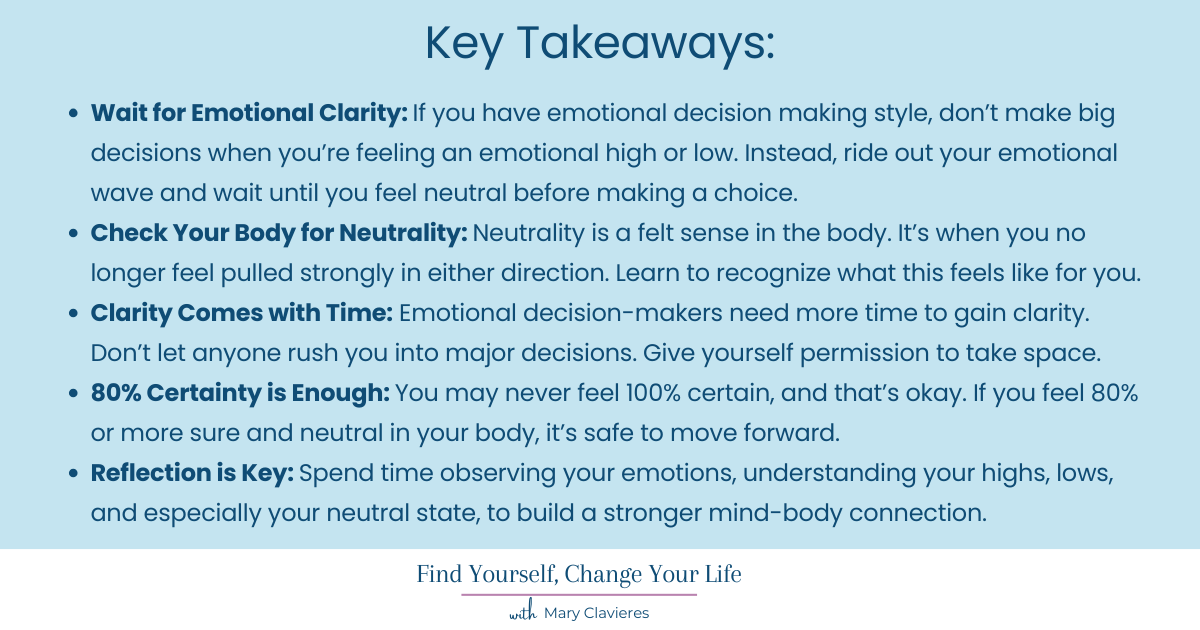
If you're just starting out and you learned today that you have emotional decision making style, you can start with:
Observing your emotions
Riding the highs and lows
Waiting until you feel neutral (a felt sense in the body) before making a decision
Remembering that decision may be with 80% certainty or more, might not be 100%
That's the main thing I want you to take away. But it's even more important for you to be in tune with how *you* operate because you have your own unique way.
Resources to Support You and Your Decision Making Style
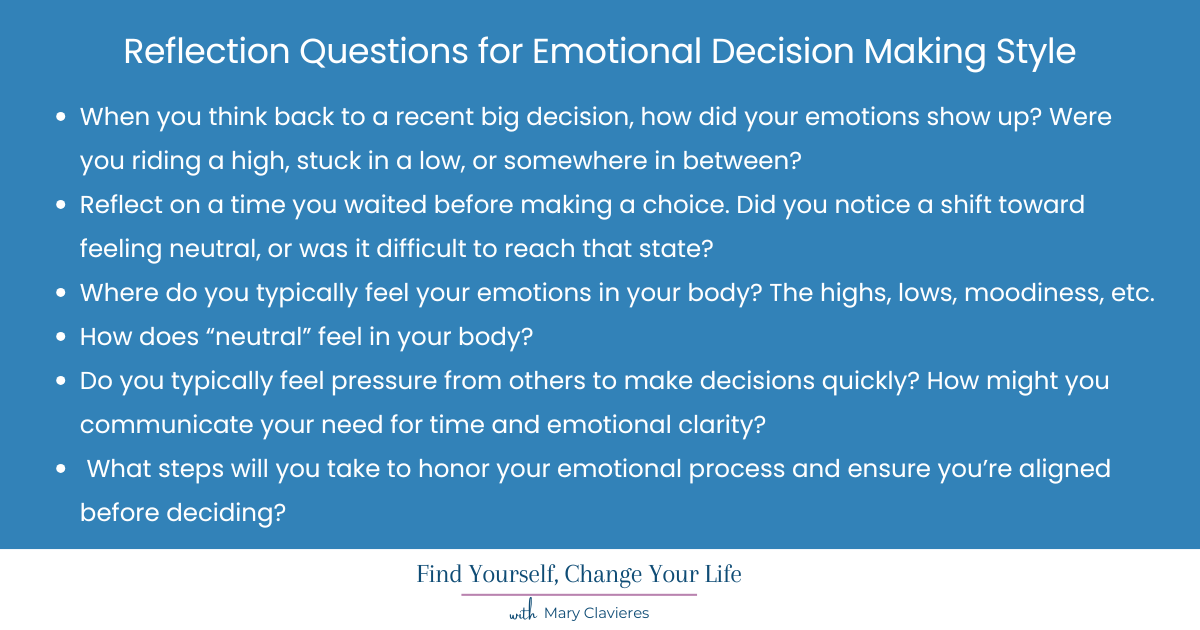
I created a free workbook for this Decision Making Series. It includes a summary of what I'm covering in this episode and reflection prompts specifically for the emotional decision-making style. If you want to look at this further, really the first step is paying attention and observing your emotions, and identifying what neutral feels like to you.
Download the Decision Making Workbook Here
If you want more support and a more detailed session, I offer a Decision Making Accelerator. It's a one-time session where we go through your specific chart and your specific decision-making style. You can bring a decision you're navigating right now (you don't have to, but if you're in the middle of a challenge, I'm happy to talk through that with you).
What we'll do is I'll go through your chart ahead of time, and then we'll talk through your specific situation and how you are meant to make decisions. Depending on which emotional waves you have, it might show up differently for you. There are other things to consider, and honestly, I can talk about human design all day long—there's so much information.
But this podcast isn't an information dump, and honestly, even my sessions aren't meant to be information dumps. I'm going to share with you how your style works. You will take away a practical tool and next steps to support you in your journey. Because I'm all about making this work. If we just spout out information and you're not able to do anything with it after, then what's the point?
I'm here to support you in being able to take action with these things and get different results in your life because of it.
Book a Decision Making Accelerator Session
Your Homework This Week
Observe your emotions. Identify what neutral feels like to you.
If you want to get the workbook to write out a couple more reflections, you can download that here. If you're interested in the Decision Making Accelerator session, you can learn more here.
I'm here to support you, so if you have questions or you need anything, please let me know.
What's Next
We will continue the series next week with sacral decision making style. I'm so excited that you're here!
If you have a friend that might benefit from this episode, please feel free to share it with them or share the series. The more people that it gets out to, the more people might be opening to their mind-body connection, which makes me super, super excited.
Thank you so much for being here. I really appreciate your support. I hope you enjoyed this episode, and I'll talk to you next week.
Want to learn more about your unique decision making style? Get the free workbook here.
New to Human Design? Get your free chart here.
Want to stop overthinking and make start making decisions with clarity, confidence and alignment?
You’re invite to book a Decision Making Accelerator session here.
Mind-Body Connection Unlocked Book:
My new book, Mind Body Connection Unlocked, is now officially out in the world! Order your copy and dive into how mind and body alignment can support lasting change in your life.
Get Your Copy of Mind Body-Connection Unlocked
Connect with Mary here:
Linkedin: https://www.linkedin.com/in/mary-clavieres-19917a7/
Instagram: www.instagram.com/mary.clavieres
Voxer: @ maryclavieres
Catch up on the Decision Making Series:
Other episodes you may enjoy:
Setting Your Intention for the Year Ahead
Understanding Your Soul: Unlocking Deeper Connection and Purpose
Understanding Your Body: The Power of Tuning In and Listening to Yourself
Understanding Your Mind and the Tricks It Plays on You
Human Design Explained: Understanding Your Unique Energy Blueprint
The Future Belongs to Authentic Self Expression
Behind the Scenes of Mind Body Connection Unlocked Plus a Reflection Activity
