
#50: How to Trust Your Body When Making Decisions [Sacral Authority | Decision Making Series]
Hello and welcome to Find Yourself, Change Your Life. I'm your host, Mary Clavieres. This podcast is here to help you rediscover yourself and become the leader of your life, however you want that to look.
Today we're continuing the Decision Making Series. If you're just joining us for the first time in this series, you can go back a couple episodes and listen to Episode 48, which is the kickoff. In that episode I cover a lot of the foundation and groundwork about decision making, how we're typically conditioned in our lives and the tool that I use, which is Human Design, for better understanding your decision-making style.
If you're jumping into this episode because you've been following along or you found out that you have sacral decision-making style, or know someone who does, that's great because that's what we're covering today.
All the links are down below, and if you want to follow along by getting your own Human Design chart and the workbook, you can do that here.

What Is Sacral Decision Making?
Sacral decision-making is the second of the seven decision-making styles. These do go in a hierarchy—I'm not teaching all the details about how you arrive at that, but if you've found on your chart that you have this style, or you know someone who does, I'm going to share today some of the things about how you can work with this.
This whole process of learning your decision-making style is really a game changer. I hope that for you, once you see it, you can't unsee it, and that it really supports you in your life for where you are right now and any changes or transitions that you're going through. It's about helping you understand how you can better decide for yourself and how you can be in alignment with yourself as much as possible.
How Sacral Decision Making Operates – How to Trust Your Body
Sacral decision-making style comes from the sacral center in the body, and this is all about the body's gut response. It's really in-the-moment answering to things, typically in a yes/no fashion. So yes/no questions are really supportive for someone that has this style.
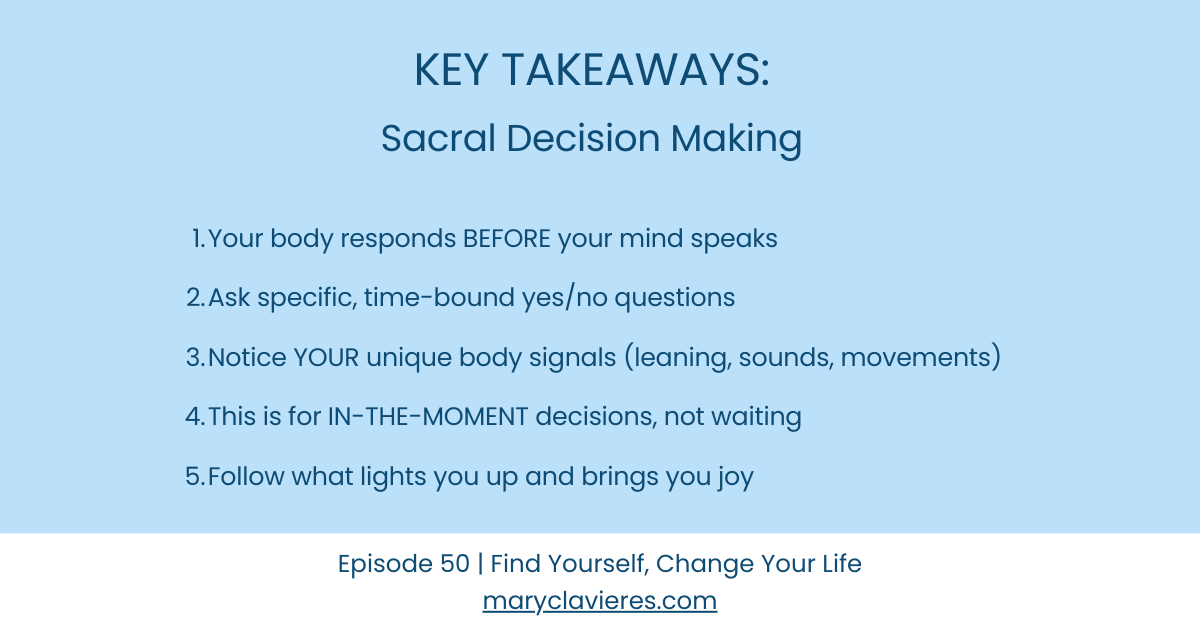
The big thing to be aware of with this is that it's not really about what you say. It's not really about if you respond yes or no to something. It's about how your body responds before you actually speak it out loud.
This is a really big thing. It's about how your body responds before you speak about it out loud. Because if you're speaking about it and giving reasoning to something, that means you're in your mind and you're using your mind—which is fine, you're allowed to use your mind, of course. But we're talking in this series about how you can be more connected with your body and be using that as your true compass.
In the case of this decision-making style, you want to start paying attention to how your body is responding to something before you say yes or no.
Ask Specific, Time-Bound Questions
I mentioned that yes/no questions can be really supportive for someone with this style. Another piece of that is making sure that those questions are time-bound in some way.
So not just saying, "Do you want to go on vacation?" but asking, "Do you want to go on vacation this summer for two weeks?" Or "Do you want to travel tomorrow for work and be away for six weeks?" Those might give very different responses.
It's not just about "Do you want to travel?" but specifying it a little bit more. Within that—having that question, having something posed to you—the next part is your body response to it.
Your Unique Body Signals
This may be a noise from your body. It could be an "uh-huh" or it could be shaking your head no or nodding your head yes. It could be leaning forward if it's something that you're feeling an agreement on, or leaning backwards if you're like, "Oh no, that's a no." It could be shrugging your shoulders if you're not sure.
All of these are different possibilities of how your body might respond. And it's important to figure out for you how your body uniquely responds. Because everyone with this decision-making style doesn't respond the same way.
Part of this is also discovering how you uniquely operate within it. I'll leave you with some reflection questions and prompts at the end of the episode too.

Make it stand out
A Client Example: When Words Don't Match the Body
I'll give you an example. I had a client once and we were on Zoom. I was talking to her about something and I asked her a question. She said yes. "Do you agree with this?" Whatever it was that we were talking about, she said yes.
And she was leaning back in her chair and started to cross her arms and stuff. And I'm thinking, "Okay, well, your sacral response is saying no right now."
It's actually very helpful for me to be able to support people in a better way by also knowing their chart and understanding this about them, because I can coach and advise them in ways that are more unique to them.
In this case, it prompted a conversation about this and really to dig into where was the feeling in her body where something was feeling no even though she was speaking out a yes. Sometimes it can be hard for us to see it for ourselves. These visual cues—it's helpful for someone else to be able to see.
"Use Your Words" and Why I Stopped Saying It
I'll give you another example that's more personal. One of my daughters has this decision-making style. When she was little, I used to tell her all the time to use her words. I'd say, "Use your words." I would ask her something and say, "Use your words," because I knew she could speak, but I wasn't hearing a response from her.
Well, I learned about Human Design and these decision-making styles and realized that I was not really supporting her in the best way that I could. I was trying to force her to speak and get her mind involved when her body was already naturally giving responses.
The thing is, with kids, they live more in alignment than we do as adults. They're less conditioned, so they are more of their truer selves. In her case, if she was responding to something with her sacral response, it wasn't about saying it. It was about just letting her body do the thing and letting her body decide.
When I learned this, I stopped asking her to use her words and I would ask her questions. I'd support her with yes/no questions, and I would look at her while I was asking the question so that I could see what her body was doing in real time. I'd say, "Okay, I saw her body response, I'm good to go."
It was really about getting a true sense of what she was navigating or how she felt about something instead of me forcing her to respond. She was already responding actually. So by forcing her to say yes or no, I was almost asking her to respond twice.
Follow What Lights You Up
This decision-making style is meant to decide in the moment, and it's really a gut response to what lights you up and brings you joy. Because anyone with this decision-making style has one of two energy types. I won't go into the details of all that—I might do a series on that at another point too if people are interested.
Basically what it means is with those two types of energy and how you operate, you're really meant to follow what lights you up and follow those sparks of joy. So that's another way that you can think about this when you're tapping into your body response.
How to Support Yourself with This Style and How to Trust Your Body
You may look at this through different lenses depending on what else is happening in your chart. You may look at it through a lens of your identity and purpose—how does it connect with your purpose? It might be related to your health and safety, or it might also be related to pressure. Is something worth entering into pressure for or not?
I'm not getting into those details for this episode because of course, everyone's charts are different. But the main thing to be looking at right now is: are you paying attention to your body response? What are your own unique body signals?
Are they leaning forward and leaning back? Are they the "uh-huh" and "uh-uh"? Are they something else? This is a really key part of being able to then see how things work for you.
Discovering Your Body's Language
If you're not sure about this, you're not sure how you respond, you could ask people—you could ask people to give you feedback on what they see of how you respond. You might also take a look in the mirror or pay attention when you're on a Zoom call. What are the different things that you do when you're interacting with someone else?
It's an opportunity for you to see how you're physically moving around, because that can be a big key for you into better understanding what your cues are, what your body signals are, so that you can use that to support you too.

Make it stand out
To Recap
Sacral decision-making style is all about being in tune in the moment, listening to those body responses to ideally specific time-bound yes/no questions in order to see if something lights you up—yes or no—and what you want to follow.
You can also talk with some of your close friends, loved ones, colleagues, whoever, about how to better support you by saying, "Actually, the best support you can give me is to ask some specific yes/no questions to help me get to my true answer."
It's not about asking someone to help you by giving you the answer, of course. It's about having them support you while you figure out the answer for yourself.
Resources to Support You
I have a workbook—there's a free workbook associated with this series. You can go in the show notes and grab that workbook and you'll have some reflection questions in there for each of the decision-making styles. So you can find the sacral style and have a little time to reflect on those questions, see how you do with them. There's some extra resources and things all within the workbook.
Download the Decision Making Workbook Here
Your Homework This Week
Start thinking about this process and what is something that you've learned from everything that you've heard today as it relates to your style. What's an aha for you in some way? What is something that you didn't know before or maybe you knew but forgot about? This is a good reminder.
I'd really encourage you to take a look and start getting curious about your own body's cues and seeing how you can incorporate this more, seeing where you can get support with getting asked yes/no questions that are specific and time-bound.
All of these decision-making styles are meant for big life decisions. It's not necessarily "What do I want to eat today?" You need to pay attention to the level of the decision-making that you're doing.
But I will say for sacral decision-making style, this is something that you can be tapping into all the time. It's actually a great practice to practice being present with yourself, practice being in tune with your body's responses and understanding what that means for you.
There's so many different ways you can open your mind-body connection. If you're not familiar, you can also grab Mind Body Connection Unlocked, which is my book that speaks all about different tools and practices that you can use to get more in tune with yourself. But this is just one of the ways that you can explore it more.
Follow whatever you feel called to from this episode. It's always take what resonates and leave the rest.

What's Next
Grab the workbook, see where you want to reflect, and allow yourself to get curious about it and allow yourself to become more in tune. It's really so amazing when you start doing this on a regular basis, getting curious and working with it. It's going to be a game changer. Very honestly, it'll be a game changer in your life.
I'm so excited to share this with you and to be working through each of these decision-making styles with you in this series. Please be sure to tune back in next week. We'll be covering splenic decision-making style.
This whole series will be mapped out. If you end up wanting to look up family members' charts and see what they have, because that's a whole other piece of the conversation—how we can support each other when we know each other's different styles.
In my family, there's four of us and all four of us have different decision-making styles. So it's really helpful to know what we're asking of other people and what we're being asked ourselves and how we stay in alignment with that while also honoring whoever else is involved. There's just so many things with it.
I hope you found this episode helpful for where you're at. Again, feel free to grab the workbook to learn more and do more reflecting. You can get your free chart as well. That's in the show notes. If you have any questions, reach out. You can connect with me on social media.
Maybe if you feel called, share this episode with a friend—share it with someone that might want to learn about this or learn about their decision-making style. Or maybe they'll want to learn about your decision-making style so that they can better support you too. We're all in this together.
Thank you for being here. I know your time is valuable and I appreciate your support, and I'll talk to you next week. Bye for now.

Links & Resources
Get Your Free Human Design Chart
Download the Decision Making Workbook
The Decision Making Accelerator:
Book a Decision Making Accelerator Session Here
Connect with Mary:
LinkedIn: linkedin.com/in/mary-clavieres-19917a7/
Instagram: @mary.clavieres
Voxer: @maryclavieres
Read Mary's Book:
Mind Body Connection Unlocked is now available! Order your copy and dive into how mind and body alignment can support lasting change in your life.
Previous Episodes in the Decision Making Series:
Other Episodes You May Enjoy:
Setting Your Intention for the Year Ahead
Understanding Your Soul: Unlocking Deeper Connection and Purpose
Understanding Your Body: The Power of Tuning In and Listening to Yourself
Understanding Your Mind and the Tricks It Plays on You
Human Design Explained: Understanding Your Unique Energy Blueprint
The Future Belongs to Authentic Self Expression
Align Your Mind and Body With This Simple Visioning Exercise
