
#68: Family Dynamics and Energy Types: How to Stop Expecting Everyone to Operate Like You Do
Hello and welcome to Find Yourself, Change Your Life. I’m your host, Mary Clavieres. This podcast is here to help you rediscover yourself and become the leader of your life, however you want that to look.
In today’s episode we are talking about family dynamics and the energy types. I’m going to get a little bit into Human Design with this one. If you’re not already familiar with Human Design, you can go check out Episode 40 as an intro… that’ll give you some of the highlights. You don’t have to know it in detail for what we’re talking about here today.
Why Family Dynamics Are So Complicated
When I’m talking about family dynamics and the energy types, it’s really around how everyone in the household unit works together — how they work individually and then how they work together.
There are many different things, of course, that go into someone’s unique and individual expression. What I want to speak to today is about what happens when different people within the household are operating differently from an energy standpoint.
I’ve actually been doing quite a few family style readings lately where people have asked me — they’ve been learning Human Design for themselves and then they come back and ask about their children or their spouse and how things are working or not working and all of that type of thing.
And from my own personal experience in my household, we have two different energy types in our family of four and it really shows up all the time in different ways, which brings up interesting conversations for myself and my husband and even with my daughters because I started explaining some of this to them as well.
The Two Big Categories of Energy
Basically there are five energy types in Human Design. The types are how you work, how you’re meant to move about the world. Each energy type has its own way of how its aura works, how it interacts with other people and so on and so forth.
I’m not going to go into teaching the five types today — I do talk about them in Episode 40. This is more to say that when you have the different types in your same house, it can really change dynamics.
And I believe this is a lot of where there’s layers to it, but it’s one of the places where communication can get murky sometimes or people feel very misunderstood. And it has to do at the base of it with how people are operating and how some people operate differently than others.
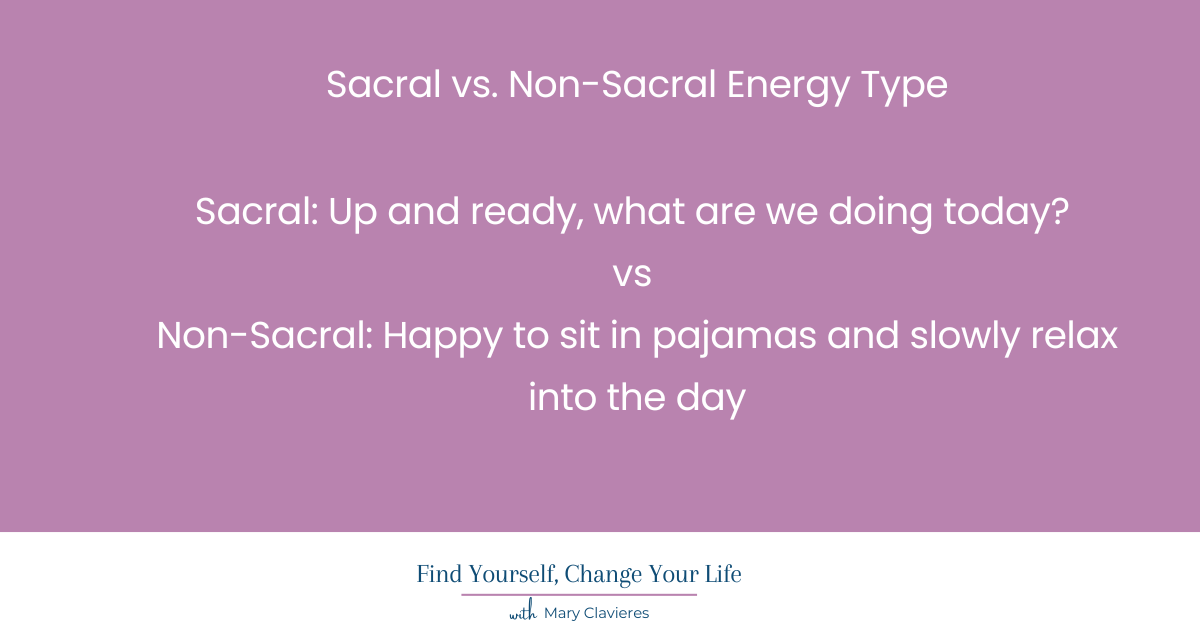
The simplest way to understand the energy difference is this: some people have a defined sacral — which is the energy battery of the body. They wake up with consistent access to energy and are meant to follow what lights them up throughout the day until they get tired and go to sleep.
Then there are non-sacral beings — projectors, manifesters, and reflectors — whose energy goes more in waves. They don’t have consistent access to that same energy battery.
Saturday Mornings in My House
I do have one sacral-defined child and one non-sacral child. And I see this show up most clearly when we’re on vacation or on weekend mornings when they’re not in school.
My sacral-defined daughter will be up and ready in the morning and before I’ve had breakfast she’ll say, what are we doing today? What are we doing this morning? What are we doing later? What are we doing? She’s ready to go, she’s ready to do a lot of things.
My other daughter, non-sacral being, is happy to sit in her pajamas for the first half of the day and just slowly relax into the day. She actually gets pretty upset if we have plans too early in the day because she needs that rest time.
And I think a lot of it is probably because she’s recovering from the week of going to school every day. It’s a lot on her system to be on all the time throughout the week.
This is very similar to how I felt growing up as well, because I’m also non-sacral — I’m a projector type. I didn’t always have that energy. But when you go to school or you go to work for the whole day and you’re always on and you’re forcing yourself to be on because you’re conditioned and you have to go with these things — it can really take a lot out of you when you get back home and you need a lot of rest.
I actually look back at my earlier working years before I had kids and I think, what did I do with my time? And I have to say I slept a lot when I wasn’t working. And I think now when I look back, a lot of that was because I was working so much and always on. I needed to recover and recuperate and that was through resting at home.
My Husband vs Me on a Saturday Morning
My husband has a defined sacral and I do not. So we have many a conversation about what that looks like and what the expectations are of what I feel up to doing or not doing.
He might have already gone to the market because he likes to go to the market on Saturday mornings. He might have gone to the market, run some other errands, went to the gardening place — all kinds of things. He could have made two or three stops in the morning.
And by the time he’s back, I’m still kind of like… I’m getting up, I’m having my breakfast, I’m maybe on my second cup of tea. I’m still in wake up mode.
Where he is, when he gets up in the morning, he is up and he’s ready to go.
What This Actually Changes
I love talking about family dynamics from a Human Design perspective — from an energy perspective — because it’s something that can just bring so much more clarity to how you’re all operating. And it can really kind of loosen some of those expectations of, well, I do it this way, why can’t you also do it this way?
There has to be some understanding there that can lead to then compassion and empathy for the other person.
If I had to guess, I would say that the non-sacrals may find themselves having to advocate more often for their own energy and how they work, if they’re working on deconditioning. Because if you’re trying to be more of who you really are and embrace how your energy works, you might need to advocate that for yourself. Because our sacral counterparts, they’re not going to understand it the same way.
The more you can do to explain that, the more helpful it can be. And vice versa as well. It’s just about how it helps you to set expectations and have clearer communication in the household.
Decision Making Styles Add Another Layer
Then the same can be true for even how you approach things for your children with school and the dynamics of going to school and what that might take out of them energetically for the day, or how you advocate for them.
I have a series around decision making that starts at Episode 48. And you can learn about how each person in your family is designed to make decisions differently.
If you have one person in the house that is meant to make decisions in the moment and another person where clarity comes over time, you can see how that can create friction if you don’t have clarity and clear communication around it. And you don’t have kind of like a plan for how you best support each other.
Your Family Is Part of Your Process
Our family is a huge part of our process and our life lessons and what we’re here to do. And yes, you can work on yourself all day long, but if you’re also living as part of a family unit and not aware of that, it’s just going to be so much harder.
So advocating for ourselves, then advocating for our children, and then working with our spouses in ways that bring more common ground and understanding — especially as you’re changing and evolving, you want to be seen in those ways. So it all ties together.
If you’re interested in learning more about this, you can go check out my website. I have decision making readings on there and a more standard Human Design reading. And if you’re looking for something more specific to your family, just reach out and let me know.
I’m also going to weave in some of this family Human Design dynamics as I launch the community later this year in the fall, because I think it has such a big impact on how we work with ourselves and do our own self inquiry and connect more deeply to our purpose.
Let’s keep this conversation going. Find me on social at the links below, and know that in this busy world, I deeply appreciate your time and presence here. You can find me on LinkedIn and Instagram @mary.clavieres, or check out my website for resources, book info, and Decision Making Accelerator sessions.
Thank you so much for being here and for listening. If you like this episode, let me know. I can cover more of these style topics, so feel free to reach out or even write a review if you feel so called. Thank you so much again. I hope you have a great rest of your day and I’ll talk to you next week.
Frequently Asked Questions
Q: What are the five energy types in Human Design? A: The five energy types are Generators, Manifesting Generators, Projectors, Manifesters, and Reflectors. Generators and Manifesting Generators have a defined sacral center — the energy battery of the body — which gives them consistent access to energy throughout the day. Projectors, Manifesters, and Reflectors are non-sacral types whose energy works differently, more in waves. You can learn more in Episode 40: Human Design Explained.
Q: How do family dynamics connect to Human Design energy types? A: When different people in a household have different energy types, they naturally operate on different rhythms. One person might be up and ready to go first thing in the morning while another needs a slow start. One person might have endless energy for activity while another needs regular rest to recover. Understanding these differences (rather than assuming everyone should operate the same way) can transform how you communicate and set expectations with family members.
Q: What is a sacral being vs a non-sacral being? A: A sacral being (Generator or Manifesting Generator) has consistent access to the body’s energy battery. They tend to have steady energy throughout the day and are designed to follow what lights them up and brings them joy. A non-sacral being (Projector, Manifester, or Reflector) doesn’t have that consistent energy access. Their energy comes in waves, they need more rest, and they can easily over-extend themselves by trying to keep up with sacral types.
Q: How do I find out my family members’ Human Design types? A: You can get a free Human Design chart at maryclavieres.com/getyourchart. You’ll need each person’s birth date, birth time, and birth location. The chart will show you their energy type, strategy, authority, and more.
Q: What if my partner and I have different energy types? A: This is very common and completely workable… it just requires awareness and communication. As Mary shares in this episode, her husband has a defined sacral and she doesn’t. He might have run three errands by the time she’s finishing her second cup of tea on a Saturday morning. Understanding that these differences are design-based rather than personality flaws can lead to more compassion and clearer expectations between partners.
Q: How do I support a non-sacral child? A: First, get curious about their chart. Non-sacral children need more recovery time… especially if they’ve been in school all week where they’re expected to be “on” all day. They may need slower mornings, earlier bedtimes, and less scheduled activity than sacral children. Avoiding early morning plans and allowing them to ease into their day can make a big difference to their wellbeing.
Q: What about decision making styles in families? A: Decision making styles are another layer entirely. If one person in the household makes decisions best in the moment (like sacral authority) and another needs time for clarity to emerge (like emotional authority), this can create real friction. Understanding each other’s decision making styles — covered in Mary’s Decision Making Series starting at Episode 48 — can help families support each other better.
Q: Can I get a Human Design reading that covers my whole family? A: Yes. Mary has been doing family style readings and is also planning to incorporate family Human Design dynamics into her community launching in fall 2026. Visit connect on social to learn more about what’s available.
Want to learn more about your unique Human Design blueprint?
Want to stop overthinking and make start making decisions with clarity, confidence and alignment?
You’re invite to book a Decision Making with Human Design session here.
Mind-Body Connection Unlocked Book:
My new book, Mind Body Connection Unlocked, is now officially out in the world! Order your copy and dive into how mind and body alignment can support lasting change in your life.
Get Your Copy of Mind Body-Connection Unlocked
Connect with Mary here:
Linkedin: https://www.linkedin.com/in/mary-clavieres-19917a7/
Instagram: www.instagram.com/mary.clavieres
Voxer: @ maryclavieres
Listen to the Decision Making Series:
Episode 49: How to Make Better Decisions When You Need Time to Process (Emotional Authority)
Episode 51: Real-Time Decision Making: How to Trust Your Intuition in the Moment [Splenic Authority]
Episode 53: How to Make Sound Decisions by Talking It Out [Self-Projected Authority]
