
Hello and welcome to Find Yourself, Change Your Life. I'm your host, Mary Clavieres. This podcast is here to help you rediscover yourself and become the leader of your life, however you want that to look.
Today we're continuing the Decision Making Series. If you are new here, I have an episode a few weeks back, Episode 48, that kicks off this series and lays the groundwork for what we're talking about. So I go all into decision-making using the mind-body connection, conditioning and how we're typically influenced by others. It's all in there to really give you a foundation in what we're talking about. And then each of these weeks we're going through one of the decision-making styles.
I use Human Design as a tool to talk about each of these styles. You can download your free chart here and follow along in the section where it says authority… that will be your decision-making style.
Have you ever had a moment where you finally said something out loud... and suddenly everything clicked?
You weren't looking for advice. You didn't need someone to tell you what to do. You just needed to hear yourself say it.
And in that moment, you knew. The answer was obvious.
If this sounds familiar, you might have self-projected decision-making style (also called self-projected authority or G-center authority in Human Design).
And understanding this about yourself? It changes everything.
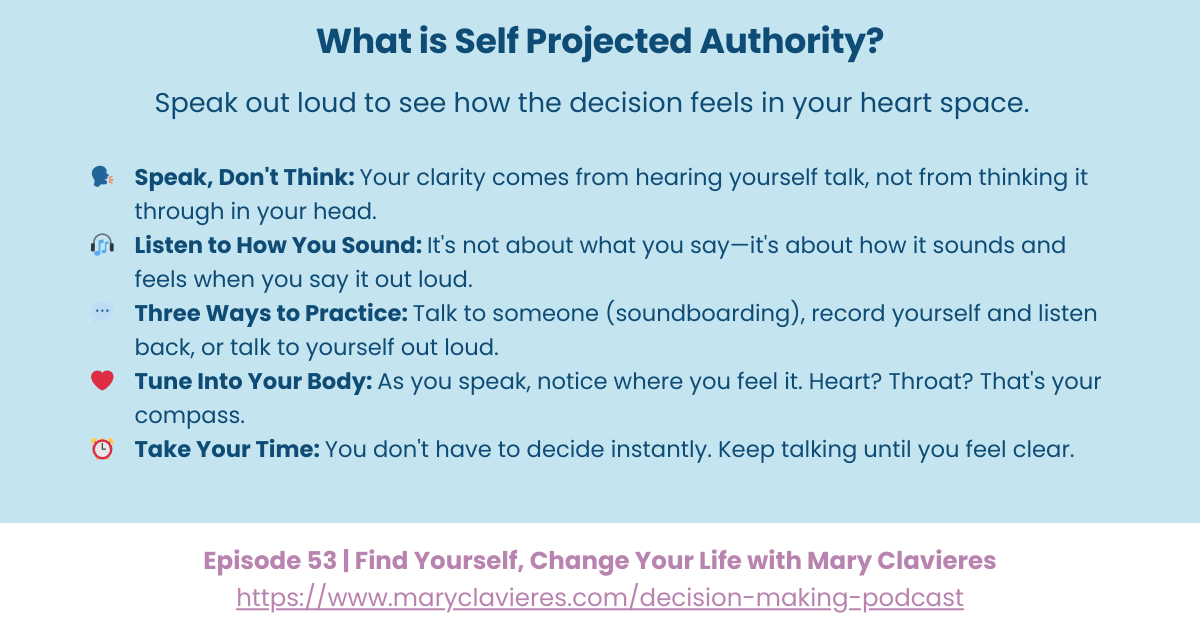
What Is Self-Projected Decision-Making?
Today we are talking about self-projected decision-making style. This can also be referenced as G Center Authority or self-projected authority. In Human Design it's called authority. I like to say decision-making style because it just makes it clear what it actually is about. For purposes of this episode, I will use self-projected decision-making style. But just know, depending on where you get your chart from, it could say G Center or Identity Center because actually this all stems from your Identity Center.
For self-projected decision-making style, what does this mean?
This style is all about speaking and hearing.
It's not even so much about what you're saying as how you're saying it, how it sounds and how you feel about it to make your decision. So this is all about speaking in order to get to your clarity.
How It Works (My Own Experience)
I can share examples from myself because actually this is my decision-making style so I'm quite familiar with it. And the way I look at it is like as you're speaking, whatever it is that you're saying, it's meant to come out however it comes out. It's not pre-planned speaking. But as you're speaking it, you will have a felt sense in your body to go along with it.
For me, that really comes from the heart space. There's really a space between my heart and my throat where I feel things. And as I'm speaking, I can tell if what I'm saying feels aligned or not. It's almost like there's a resonance to it, or there's not. And when there is, I know that what I'm saying is correct for me. And when there's not, I know that it's not correct for me or it's not the direction I need to be going in.
It's About HOW It Sounds and Feels
Now, the tricky part with this, or let's say the learning curve with this, is that you're not necessarily looking for the content of what you're saying. You're looking at how does it sound? How does it feel? Does it resonate? So you could be talking about something and you could be saying, 'Oh yeah, I really want to do this thing,' but as you're saying it, it doesn't feel right. It doesn't sound right. There's something off about it. And that's your cue to say, 'Oh, actually, I don't think this is the right thing for me.'
Conversely, you could be talking about something and you're like, 'I don't know, maybe I'll do this,' and as you're saying it, you're like, 'Oh, actually that feels really good. That sounds really good.' And you can tell that there's an alignment there. So it's really about tuning into how it sounds and how it feels as you're speaking it out loud.
Three Ways to Practice Self-Projected Decision-Making
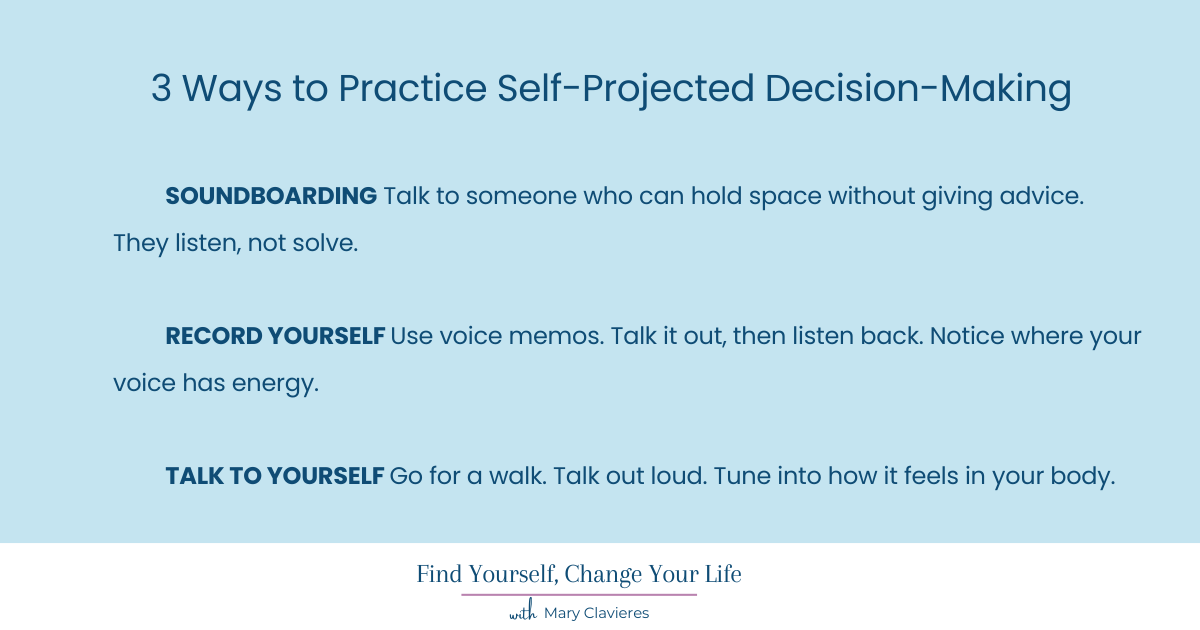
If you have this style, there are three main ways to work with it:
1. Talk to Someone Else (Soundboarding)
This is called soundboarding. You talk to someone else... but you're not looking for their advice or feedback.
You're just using them as a sounding board. Someone to talk at, not with.
The key is finding someone who can hold space without jumping in with opinions. They're there to listen. Not to solve.
If they're skilled, they might reflect back how you sounded. "You seemed really energized when you said that." Or "Your voice got flat when you mentioned this option."
But here's the challenge: Most people can't hold space this way. They want to help. They offer advice. They tell you what they would do.
And that throws you off. Because now you're processing their input instead of tuning into your own clarity.
So soundboarding can work... but only with the right person.
2. Record Yourself and Listen Back
Open a voice memo app. Hit record. And just talk.
Talk through your decision. Explore different angles. Don't censor yourself. Just let it flow.
Then listen back.
How did you sound? Where did your voice have energy? Where did it go flat?
This helps you build a relationship with your voice. You start to recognize what clarity sounds like for you.
3. Talk to Yourself Out Loud
This is my preferred method.
I go for walks. And I just... talk to myself.
I talk through the decision. I explore options. I say things I wouldn't say to anyone else.
And as I'm talking, I tune in. How does this feel? What's my body telling me?
Walking helps. Being in nature helps. Being alone and in my own energy helps.
Because when I've been around other people for too long, I start picking up their energy. And then I can't tell what's mine and what's theirs.
So I need space. Alone time. Quiet.
And then I talk. And I listen. And the clarity comes.
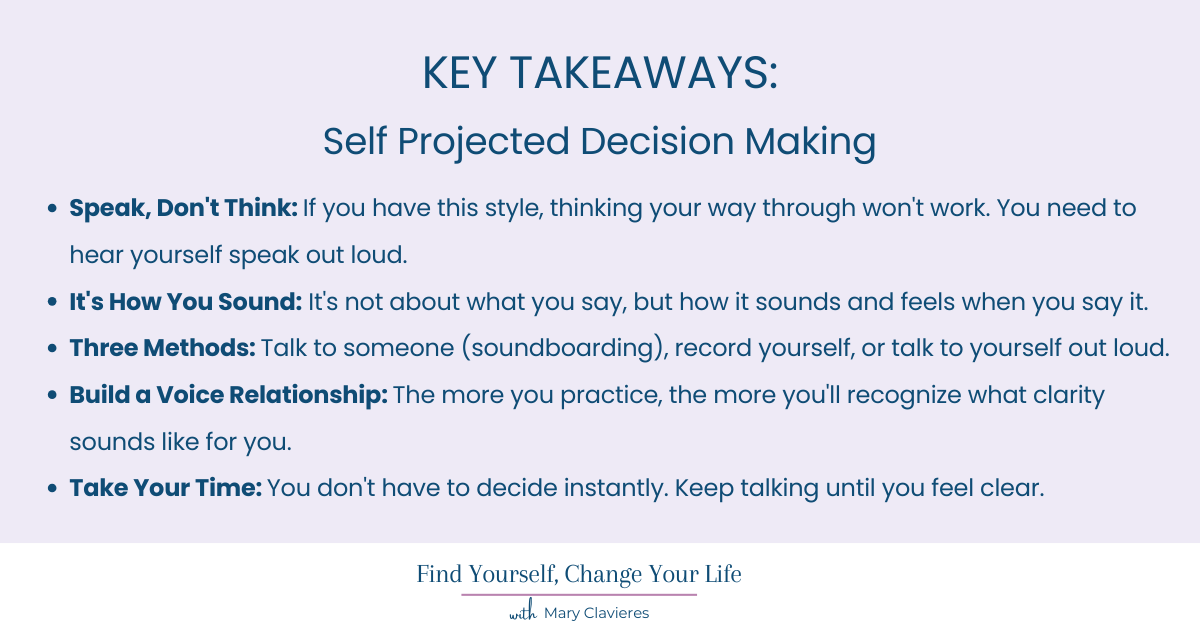
Making Sure You're in Your Own Energy
I also want to mention that it's really important when you're using this decision-making style to make sure that you're in your own energy. If you've been around other people all day or you're feeling really influenced by someone else's energy or opinions, it's going to be harder for you to tune into your own resonance. So I always recommend taking some time to yourself, maybe going on a walk, being in nature, doing something that helps you clear your energy before you start talking things out.
And then once you're clear and you're in your own space, that's when you can start speaking and really tuning into how it sounds and how it feels for you. Because that's what's going to give you your clarity.
The Challenge: Your Relationship with Your Voice
Here's what I see with most people who have self-projected decision-making:
They struggle with their voice.
They don't want to talk to themselves. They don't want to listen back to recordings. They feel awkward about it.
I get it. I felt the same way when I first learned about this.
Why do I need to talk to myself? That's weird.
But here's the thing:
If you don't develop a relationship with your voice, you'll keep outsourcing your decisions.
You'll talk to other people and ask for their input. You'll rely on their opinions instead of tuning into your own clarity.
And that's the low expression of this style. Giving your power away. Letting other people decide for you.
The high expression? Building a relationship with your voice. Learning to trust what you hear. Making sound decisions by speaking them out loud.
It's Not About Instant Clarity
One more thing:
Self-projected decision-making doesn't mean you have to decide in the moment.
Sometimes you'll speak it once and know immediately. Other times, you'll need to talk it out a few different ways. Look at it from different angles. Give it time.
I don't rush my decisions. If I don't feel clear, I keep talking until I do.
I might talk about it on a walk today. And then again tomorrow. And maybe once more the day after that.
Until I get that clear feeling. That pull. That sense of "yes, this is it" or "no, this isn't right."
Give yourself that time. Don't force it. Let it unfold.
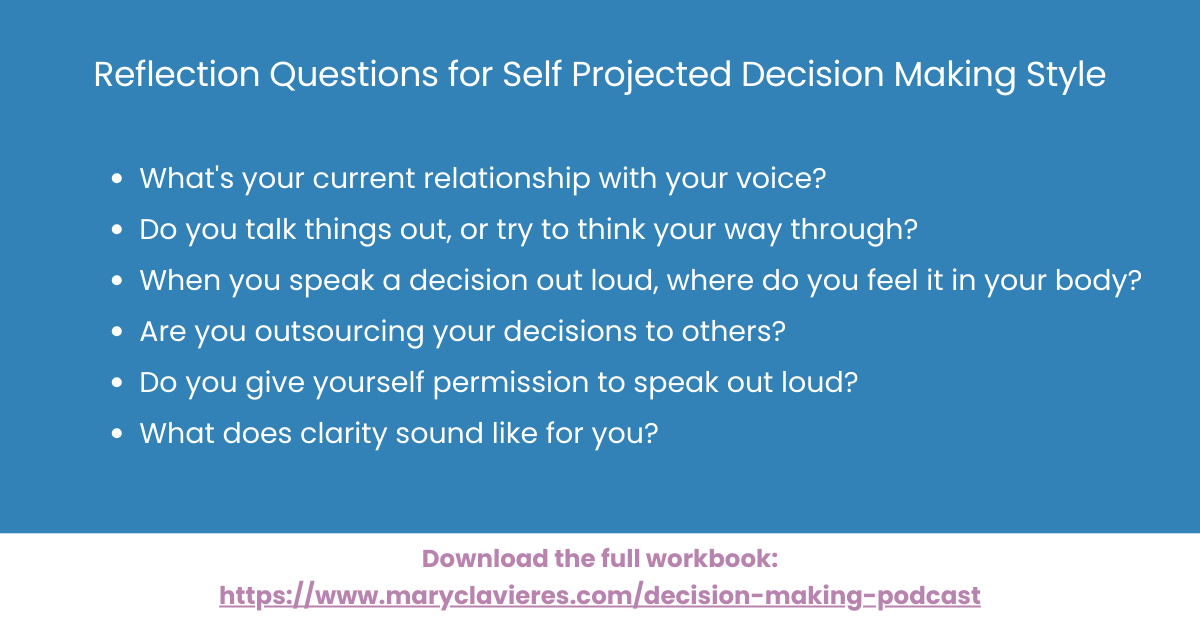
Where to Start
If you have self-projected decision-making style, here are some questions to reflect on:
Do you give yourself space to speak out loud about your decisions?
When was the last time you talked something out and felt the resonance in your body?
Are you listening to HOW you're saying things, not just WHAT you're saying?
Are you making sure you're in your own energy before making big decisions?
Who in your life can be a soundboard for you (without giving advice)?
Build a relationship with your voice. Get curious about how you sound when you're clear versus when you're not.
Pay attention to where it shows up in your body. For me, it's between my heart and throat. For you, it might be different.
And the next time you're facing a decision, don't just think about it.
Speak it. Out loud. And listen.
That's where your clarity lives.
Stay Connected
If you haven't already, grab your free Human Design chart and the workbook that goes with this series. There's a link in the show notes. The workbook has reflection questions for each decision-making style and some extra information about the centers so you can see how they all work together.
And if you want to work one-on-one with this, I do offer Decision Making Accelerator sessions. It's a one-time session where we dive into your specific decision-making style, and you'll walk away with a plan unique to you of how you can integrate this more and take this knowledge and learn to embody it. Because it's one thing to know how something works from a logical perspective, and it's another to actually use it, actually integrate it into your body and work with it.
Thank you so much for being here. If you know someone that may benefit from this information, please feel free to share it with them. It helps the podcast get seen and heard by more people, which I so deeply appreciate. Thanks again. Have a great week and I'll talk to you next time. Bye for now.
Links & Resources
Get Your Free Human Design Chart
Download the Decision Making Workbook
The Decision Making Accelerator:
Book a Decision Making Accelerator Session Here
Connect with Mary:
LinkedIn: linkedin.com/in/mary-clavieres-19917a7/
Instagram: @mary.clavieres
Voxer: @maryclavieres
Read Mary's Book:
Mind Body Connection Unlocked is now available! Order your copy and dive into how mind and body alignment can support lasting change in your life.
Previous Episodes in the Decision Making Series:
Episode 49: How to Make Better Decisions When You Need Time to Process (Emotional Authority)
Episode 51: Real-Time Decision Making: How to Trust Your Intuition in the Moment [Splenic Authority]
